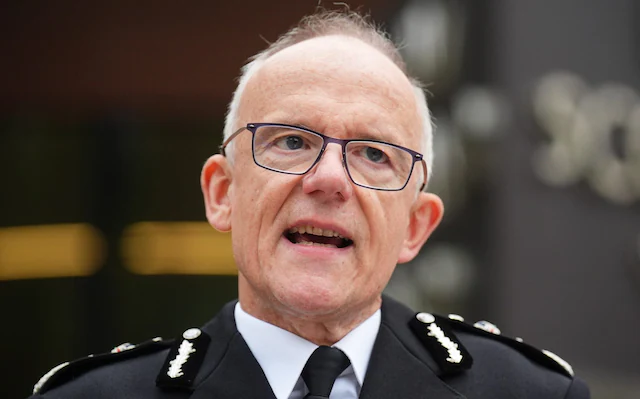
Sir Mark Rowley announces expansion of facial recognition, drones and AI as Metropolitan Police seeks to modernise crime-fighting capabilities
The Commissioner of the Metropolitan Police, Sir Mark Rowley, has unveiled an ambitious strategy to transform policing through technology, arguing that law enforcement risks falling behind increasingly sophisticated criminals unless it rapidly embraces innovation.
Speaking at an event hosted in partnership with the Police Foundation, Rowley outlined plans to significantly expand the use of artificial intelligence, drones, live facial recognition and advanced data analytics across London.
The Commissioner said modern criminals are exploiting technology at an unprecedented rate, using encrypted communications, social media platforms, the dark web, artificial intelligence and cryptocurrencies to commit and conceal crimes.
“Crime is evolving at speed,” Rowley said. “Criminals are organised, networked and digital. They are using smarter, faster and more connected tools than ever before.”
Lessons from the Past
Drawing on the history of Scotland Yard, Rowley highlighted how policing has long sought scientific and technological advantages.
He contrasted failed 19th-century practices such as phrenology and death masks with successful innovations including fingerprinting and body-worn video cameras, both of which initially faced public scepticism before becoming widely accepted tools.
According to the Commissioner, history demonstrates that while new policing technologies often generate concern, they can become essential when implemented responsibly and effectively.
AI to Cut Investigation Times
One of the centrepieces of the Met’s strategy is the wider deployment of artificial intelligence-powered video analytics.
The technology enables officers to search and analyse vast quantities of CCTV footage far more quickly than traditional manual methods, identifying people, vehicles and key events within recordings.
The Met revealed that early trials involving more than 16,000 hours of CCTV across 23 major investigations reduced review workloads by the equivalent of 454 officer days.
Police leaders believe the time saved can be redirected towards investigations, victim support and crime prevention.
Drone Network Planned Across London
The Commissioner also announced a major expansion of the Met’s drone programme.
After beginning with just two drones in a pilot scheme last year, the force now operates nine aircraft and deploys them to approximately 200 incidents every week.
Drones currently reach incidents in around two minutes on average, significantly faster than the typical police response time of nine minutes.
Rowley said the Met’s goal is to provide drone coverage in every London borough within the next year.
The force is also seeking to work with emergency service partners, including the London Fire Brigade and ambulance services, to develop a shared citywide drone infrastructure.
The proposed network would allow emergency responders to share launch sites, communications systems, airspace management and operational data, reducing duplication while improving response times.
Facial Recognition Rollout Accelerates
Perhaps the most significant announcement was the expansion of Live Facial Recognition (LFR) technology.
The Met has used mobile facial recognition vans for several years and has recently tested fixed cameras mounted on existing street infrastructure.
According to police figures, LFR operations have contributed to more than 2,000 arrests since 2024. Officers also reported that one-third of registered sex offenders identified through the technology were found to be breaching licence conditions that had previously gone undetected.
The Commissioner argued that facial recognition has proven both effective and proportionate, citing public support and higher arrest rates compared with conventional stop-and-search tactics.
As a result, the Met will begin making static facial recognition cameras a permanent feature in parts of central London, with plans for broader deployment across the capital next year.
Unlocking the Power of Police Data
Beyond frontline technology, Rowley argued that one of policing’s greatest challenges is making better use of the enormous volume of information already held by law enforcement agencies.
The Metropolitan Police currently manages more than 2,200 datasets across over 600 systems, alongside millions of body-worn video recordings and hundreds of thousands of forensic submissions each year.
The Commissioner warned that fragmented information systems can prevent officers from identifying patterns of offending and safeguarding risks.
He pointed to repeated findings from domestic homicide reviews and child safeguarding investigations, where failures to connect existing information have often contributed to tragic outcomes.
The force believes modern data integration and AI-powered analytics could help officers identify prolific offenders, organised crime networks and vulnerable victims far more quickly.
Palantir Pilot Highlights New Approach
Rowley also highlighted an internal pilot project developed with technology company Palantir.
Initially focused on professional standards and misconduct monitoring within the Met, the system combines multiple sources of information to identify patterns and risks that may otherwise go unnoticed.
The pilot covers approximately 45,000 officers and staff and has enabled the force to move towards a more proactive model of identifying potential concerns.
The Commissioner suggested similar technology could eventually be used more widely in crime prevention, helping police intervene before serious harm occurs.
Technology as a Tool for Trust
Addressing concerns about privacy and civil liberties, Rowley insisted that technology should support officers rather than replace human decision-making.
He acknowledged public concerns around data use, proportionality, accuracy and bias but argued that responsible use of technology can strengthen trust rather than undermine it.
The Commissioner said police would continue operating within existing legal frameworks, including data protection, human rights and surveillance legislation, while maintaining oversight and accountability.
He also pointed to polling suggesting strong public support for technologies that help identify serious offenders, safeguard vulnerable people and connect information across investigations.
Calls for Reform
While outlining an ambitious vision, Rowley warned that significant barriers remain.
He criticised decades of underinvestment in police technology, arguing that governments have prioritised officer numbers while neglecting digital infrastructure.
The Commissioner also renewed calls for national policing reform, saying the current system of 43 separate police forces creates unnecessary complexity and slows technological progress.
In addition, he called for changes to public sector procurement processes, describing current systems as too slow for the pace of technological change.
According to Rowley, police forces can spend more than a year simply selecting and appointing technology suppliers, by which point innovations may already have advanced significantly.
A Defining Choice for Policing
Concluding his remarks, the Commissioner said policing faces a pivotal moment.
He argued that police already possess much of the information needed to identify victims earlier, disrupt offenders faster and prevent harm more effectively. However, without modern technology, that insight often remains hidden.
The expansion of drones, facial recognition and AI-driven policing marks one of the Metropolitan Police’s most significant technology programmes in recent years, reflecting a determination to regain the advantage over increasingly digital and technologically enabled criminals.