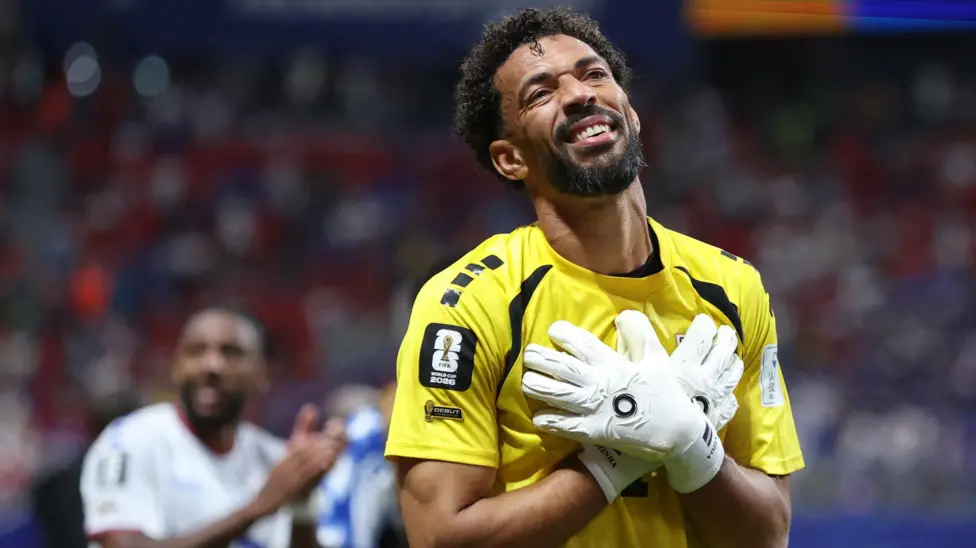
As the final whistle echoed around Atlanta Stadium, all eyes turned to Cape Verde goalkeeper Vozinha.
The 40-year-old stood motionless for a moment before emotion overwhelmed him. Tears streamed down his face as he began to grasp the significance of what he and his teammates had just achieved. Cape Verde, making their World Cup debut, had held tournament favourites Spain to a stunning 0-0 draw.
In the stands, thousands of Cape Verde supporters erupted with joy. They had spent the entire match singing, chanting, and willing their team forward. Now they celebrated together, embracing, dancing, and savouring a moment that will live forever in their nation’s sporting history.
On the pitch, players sprinted towards one another in celebration. Even neutral fans found themselves swept up in the occasion. By the end of the night, Cape Verde’s story had become everyone’s story.
At the heart of it all was Vozinha.
Facing the reigning European champions, the veteran goalkeeper produced the performance of his career. Time and again, he denied Spain with crucial saves, preserving a clean sheet and helping secure the greatest result Cape Verdean football has ever known.
When he was named Player of the Match, the emotions spilled over.
“I cried because I grew up with my grandparents,” he said. “Unfortunately, they’re no longer here. They meant everything to me.”
He also spoke about his mother, who was unable to travel to the United States.
“She couldn’t come because of visa issues and the costs involved. I wish she could have been here to witness this.”
For Vozinha, the achievement represented far more than a football result. It was the culmination of a dream he had carried for decades.
“Our greatest weapon is our unity,” he said. “People thought we came here just to enjoy the World Cup, but we came to compete. We came to fight for our country.”
Born Josimar Dias, Vozinha’s path to the World Cup was anything but straightforward. Unlike many professional footballers, he did not begin his career early. In fact, he only became a professional player at the age of 25.
“I started professional football late,” he reflected. “There were moments when I thought about leaving the national team, but I kept going because of this dream.”
That persistence paid off in remarkable fashion. At 40 years and 12 days old, Vozinha became the oldest player ever to appear in a nation’s debut World Cup match. Only Egypt’s legendary goalkeeper Essam El Hadary was older when making his own World Cup debut.
His journey began on the island of São Vicente, in the city of Mindelo. Growing up in Cape Verde, opportunities for aspiring footballers were limited.
“I was one of the best goalkeepers on my island,” he recalled. “But I was considered too small. Even when I played well, I wasn’t selected because of my height.”
Determined to succeed, he followed a path taken by many Cape Verdean footballers and moved to Portugal in search of opportunities. His career would later take him to Slovakia, Angola, Moldova, and Cyprus before eventually returning to Portugal, where he now plays for Chaves.
Even his name carries a football connection. His father wanted to name him after Argentine legend Jorge Valdano, but local authorities rejected the request. Instead, he was named Josimar after the Brazilian defender who starred at the 1986 World Cup.
Nearly four decades later, Josimar “Vozinha” Dias found himself writing his own chapter of football history on the world’s biggest stage.
Against Spain, he was magnificent.
Roared on by a sea of blue-clad supporters, Vozinha made seven vital saves to frustrate one of the strongest attacking teams in world football. Every stop was greeted with the same excitement as a goal by the travelling fans.
His heroics quickly captured global attention. Within hours, his Instagram following skyrocketed from around 50,000 to more than 1.5 million after Brazilian broadcaster CazeTV encouraged viewers to follow him.
When informed of the dramatic rise, Vozinha could only laugh.
“That’s crazy,” he said.
Football pundits were equally impressed.
Former Scotland winger Pat Nevin described the goalkeeper as the player who “lit up the game.”
“He was absolutely brilliant,” Nevin said. “To maintain that level of concentration under constant pressure at 40 years old is extraordinary. You don’t achieve that as a group of individuals. You achieve it as a team.”
Former England defender Lee Dixon echoed those sentiments.
“It’s fantastic,” he said. “Cape Verde deserved that point. Every player gave everything. Seeing Vozinha in tears almost brought tears to my eyes.”
For Cape Verde, a nation of just over half a million people and one of the smallest countries ever to qualify for a World Cup, the draw felt like a victory.
Their supporters never stopped believing. Wrapped in national colours and waving flags throughout the match, they created an atmosphere that inspired their team through every challenge.
By the final whistle, football fans around the world had fallen in love with the underdogs.
On a night when the giants of Spain were expected to dominate, it was a tiny island nation in the Atlantic Ocean that captured the imagination of the football world.
And at the centre of it all stood a 40-year-old goalkeeper with tears in his eyes, living the dream he had chased his entire life.