
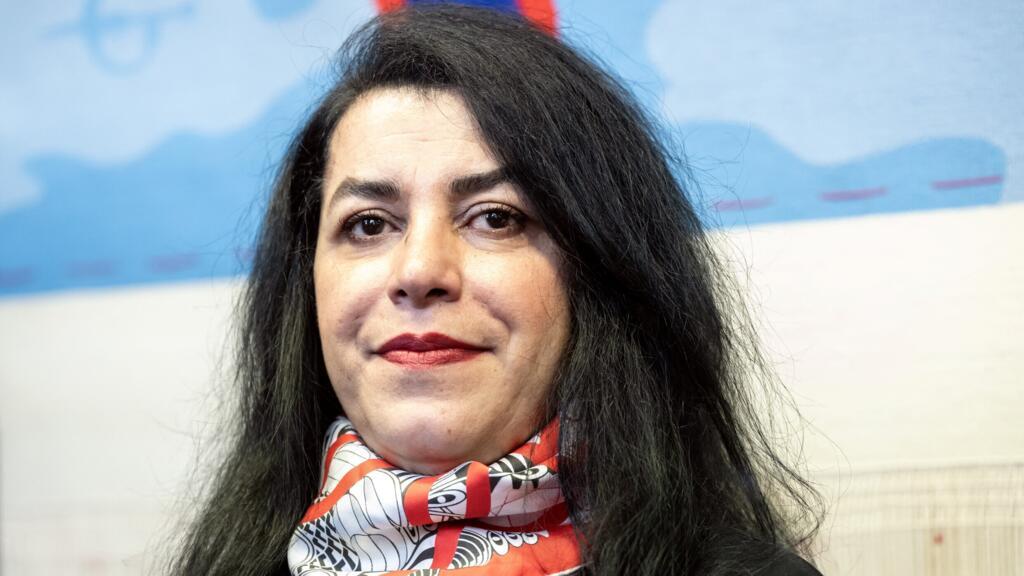
Marjane Satrapi, the acclaimed French-Iranian graphic novelist, filmmaker, and artist whose groundbreaking work Persepolis transformed personal history into a universal story of resilience and identity, has died at the age of 56.
Her family confirmed the news in a statement, saying that Satrapi passed away a little over a year after losing her husband, Swedish producer, actor, and screenwriter Mattias Ripa, whom she often described as the love of her life. Ripa died on April 8, 2025. In the weeks leading up to her death, Satrapi’s social media posts reflected the depth of her grief, carrying a simple but heartbreaking message: “For I lost the love of my life.”
Satrapi rose to international prominence through Persepolis, the autobiographical graphic novel that chronicled her childhood and adolescence during and after the Iranian Revolution. The story was later adapted into an animated film, which she co-wrote and co-directed with Vincent Paronnaud. Premiering at the Cannes Film Festival in 2007, the film received widespread critical acclaim, sharing the Jury Prize and earning an Academy Award nomination for Best Animated Feature. The nomination marked a historic milestone, making Satrapi the first woman ever nominated in that category.
The success of Persepolis established Satrapi as one of the most distinctive creative voices of her generation. She later reunited with Paronnaud for Chicken with Plums (2011), an adaptation of another of her celebrated graphic works. The film premiered at the Venice Film Festival and further showcased her ability to blend visual storytelling with emotional depth.
As a solo director, Satrapi explored a variety of genres. Her films included the crime comedy La Bande des Jotas(2012), the darkly comic psychological thriller The Voices (2014), starring Ryan Reynolds, Anna Kendrick, and Gemma Arterton, and Radioactive (2019), a biographical drama about pioneering scientist Marie Curie featuring Rosamund Pike in the lead role. Her final film, Dear Paris (Paradis Paris), starring Monica Bellucci, premiered at the Torino Film Festival in 2024.
Born in Iran, Satrapi grew up in a politically engaged family during one of the country’s most turbulent periods. Persepolis captured the upheaval she experienced as a child following the 1979 Islamic Revolution. Through the eyes of a young girl, she documented a society transformed by political repression, where friends and family members faced imprisonment, persecution, and death. One of the most painful losses she recounted was the execution of her beloved uncle Anoosh, a political prisoner whose story became one of the book’s most moving chapters.
As a teenager, Satrapi often challenged the restrictions imposed by the regime, attracting the attention of the morality police and secretly embracing banned Western music and culture. Concerned for her safety, her parents sent her to Austria at the age of 14. Her years abroad were marked by isolation, hardship, and instability. At one point, she experienced homelessness before returning to Iran after a serious illness.
Back in Tehran, she completed a master’s degree in visual communication and married Reza, a veteran of the Iran-Iraq War. The marriage eventually ended, and Satrapi returned to Europe, settling permanently in France in the early 1990s. She became a French citizen in 2006.
It was in France that Satrapi fully discovered her artistic voice. Beginning in 2000, she published Persepolis in four volumes through the independent publisher L’Association. Drawn in striking black-and-white illustrations, the series resonated with readers around the world and was translated into more than 25 languages. It sold over a million copies and helped redefine what comics could achieve as a storytelling medium.
Despite the growing popularity of the term “graphic novel,” Satrapi consistently referred to her work simply as comics. She believed the medium deserved recognition without the need for rebranding, arguing that comics were capable of addressing serious themes while remaining accessible and powerful.
Her work was inseparable from her political convictions. Throughout her life, Satrapi remained a vocal advocate for democracy, human rights, and freedom of expression. Following Iran’s disputed 2009 presidential election, she publicly challenged the official results and supported reformist voices. More than a decade later, she became one of the most prominent international supporters of the women-led protests sparked by the death of Mahsa Amini. She also helped create Woman, Life, Freedom, a graphic anthology that introduced the movement to readers around the world.
In January 2025, Satrapi made headlines when she declined France’s highest civilian honor, the Légion d’honneur. While expressing deep affection for France, which she considered her home, she criticized what she viewed as inconsistencies in the country’s policies toward Iranian dissidents and refugees.
Fluent in multiple languages and deeply connected to both Iranian and European cultures, Satrapi occupied a unique place in contemporary art and literature. She was an exile who transformed personal memories into global stories, a cartoonist who changed perceptions of her medium, and a filmmaker whose work bridged cultures, generations, and political divides.
Through her books, films, and activism, Marjane Satrapi leaves behind a legacy of courage, honesty, and artistic innovation. Her voice, shaped by loss, resistance, humor, and hope, will continue to resonate long after her passing.