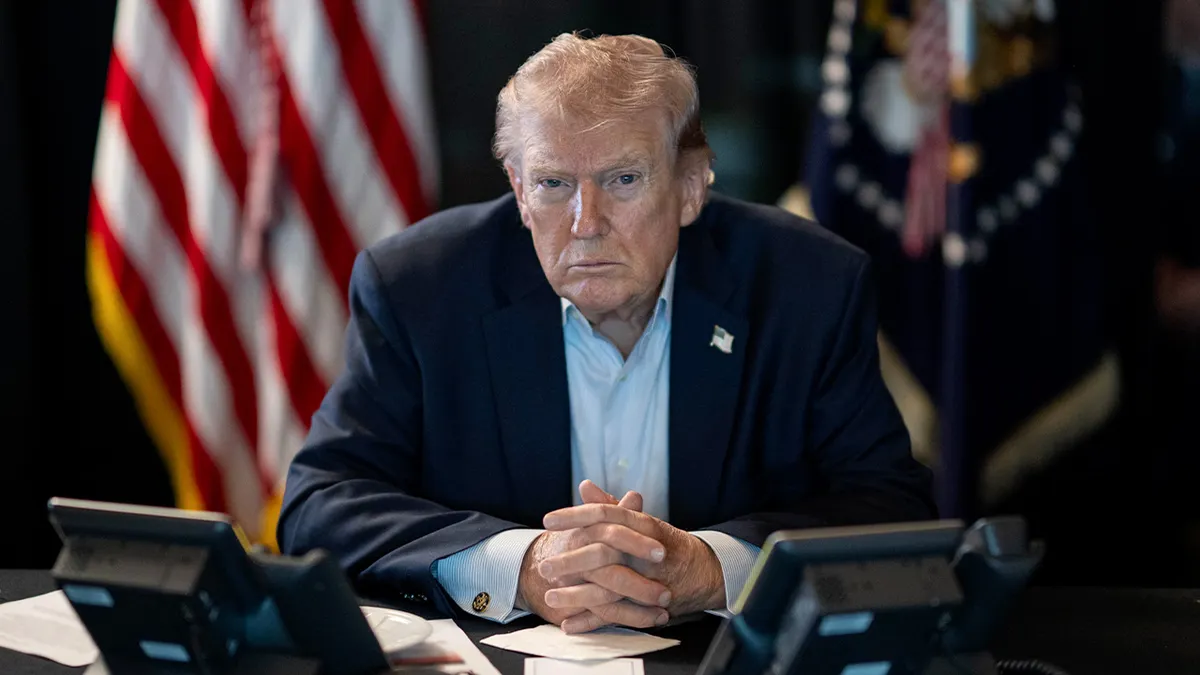
Donald Trump has announced that the Strait of Hormuz will be “fully open” by Friday, presenting a newly negotiated agreement with Iran as a major diplomatic breakthrough. However, as world leaders gathered for the G7 summit in Évian-les-Bains, concerns were already emerging that the deal could face serious challenges before it is even formally implemented.
Speaking upon his arrival in France, Trump said the agreement had already begun to take effect, noting that the vital shipping route was partially open. Yet tensions remain high, with reports of Israeli actions in Lebanon and ongoing disagreements over Iran’s role in managing traffic through the strategic waterway exposing unresolved issues.
During talks with French President Emmanuel Macron, Trump dismissed a proposal by Britain and France to launch a joint naval mission in the Strait of Hormuz, saying the United States could handle the situation without additional assistance.
Trump described the agreement as a positive development for both regional stability and global markets. He pointed to falling oil prices and rising stock markets as evidence that confidence was returning. He also stressed that the central objective of the deal was to prevent Iran from obtaining a nuclear weapon, claiming Tehran had agreed to strict monitoring measures.
The agreement, expected to be formally signed in Geneva on Friday, will reportedly involve Iran reopening the Strait of Hormuz while the United States eases its naval restrictions on the country. The signing ceremony is expected to be attended by US Vice-President JD Vance and Iran’s chief negotiator, Mohammad-Bagher Ghalibaf.
According to White House officials, the complete details of the agreement will be released within the next two days. Despite the announcement, G7 leaders spent much of their opening discussions assessing how to support and safeguard the fragile arrangement.
Technical negotiations are expected to continue this week, led by Vance on the US side. Some of the most difficult discussions will focus on Iran’s nuclear programme and the mechanisms needed to ensure it cannot be used to develop nuclear weapons.
The agreement is also expected to include sanctions relief and access to billions of dollars in previously frozen Iranian assets. However, US officials emphasised that any financial concessions would depend on Iran fulfilling its commitments. They confirmed that no assets had yet been released and said any initial easing of restrictions would be linked to reciprocal actions by Tehran.
American officials also clarified that US military forces stationed near Iran would remain in place for now. They said troop reductions would only be considered once Iran demonstrated compliance with the terms of the agreement.
German Chancellor Friedrich Merz welcomed the possibility that the deal could bring greater stability to the global economy but warned that any ceasefire arrangement must also apply to Lebanon. His comments came after an Israeli drone strike in southern Lebanon reportedly killed one person, marking the second fatality since a 60-day ceasefire was announced.
European Commission President Ursula von der Leyen echoed those concerns, arguing that lasting peace would be impossible if violence in Lebanon continued.
In Israel, reaction to the agreement was mixed. Critics argued that many of Prime Minister Benjamin Netanyahu’s original wartime goals—including regime change in Tehran and the complete dismantling of Iran’s nuclear programme—had not been achieved.
The Israeli government also continues to face challenges in Lebanon, where military operations against Hezbollah have resulted in ongoing casualties despite previous claims that the group no longer posed a significant threat.
Opposition figures and some media outlets described the outcome as a major setback. Members of Netanyahu’s right-wing coalition openly criticised the agreement, arguing that Israel was not involved in the negotiations and should not be bound by its terms.
National Security Minister Itamar Ben-Gvir stated that Israel should continue its campaign against Hezbollah and maintain control of territory captured during recent military operations.
Iran also expressed reservations. Foreign Ministry spokesperson Esmail Baghaei said the success of the agreement depended on Israel respecting ceasefire commitments, particularly in Lebanon.
Another point of contention centres on whether Iran will be permitted to charge fees for maritime services in the Strait of Hormuz. European leaders have strongly opposed any arrangement that could resemble a toll system and potentially restrict freedom of navigation.
Trump sought to ease those concerns, insisting that the waterway would remain open and free of charges. Nevertheless, uncertainty surrounding the issue has cast doubt on plans for a proposed Franco-British maritime task force intended to escort commercial vessels and clear potential threats in the region.
Macron has argued that such a force could help guarantee safe passage through the strait and suggested France could deploy significant naval assets, including the aircraft carrier Charles de Gaulle. However, the proposal appears increasingly uncertain, especially as participating nations have indicated they would not operate in direct confrontation with Iranian forces.
Meanwhile, Trump suggested shipping traffic was already beginning to return to normal, saying oil tankers were once again moving through safe routes in the region. Despite this optimism, shipping companies have warned that restoring normal trade flows could take several months.
European Central Bank President Christine Lagarde cautioned that the conflict’s impact on energy prices was still being felt across Europe, contributing to inflation and increasing pressure on wages.
Beyond the immediate challenges of implementing the agreement, Trump also faces the task of convincing fellow G7 leaders that his approach to the conflict was successful. Several leaders remain sceptical, arguing that the war weakened Western economies and damaged US credibility while doing little to strengthen the broader Western position against China.
One Western diplomat described the episode as a significant setback for unilateral American foreign policy, suggesting it could prompt a reassessment of future US strategies.
Despite the criticism, US officials maintain that the conflict has significantly weakened Iran and created an opportunity for the country to reconnect with the global economy—provided it can demonstrate, through verifiable measures, that it is not pursuing nuclear weapons.