



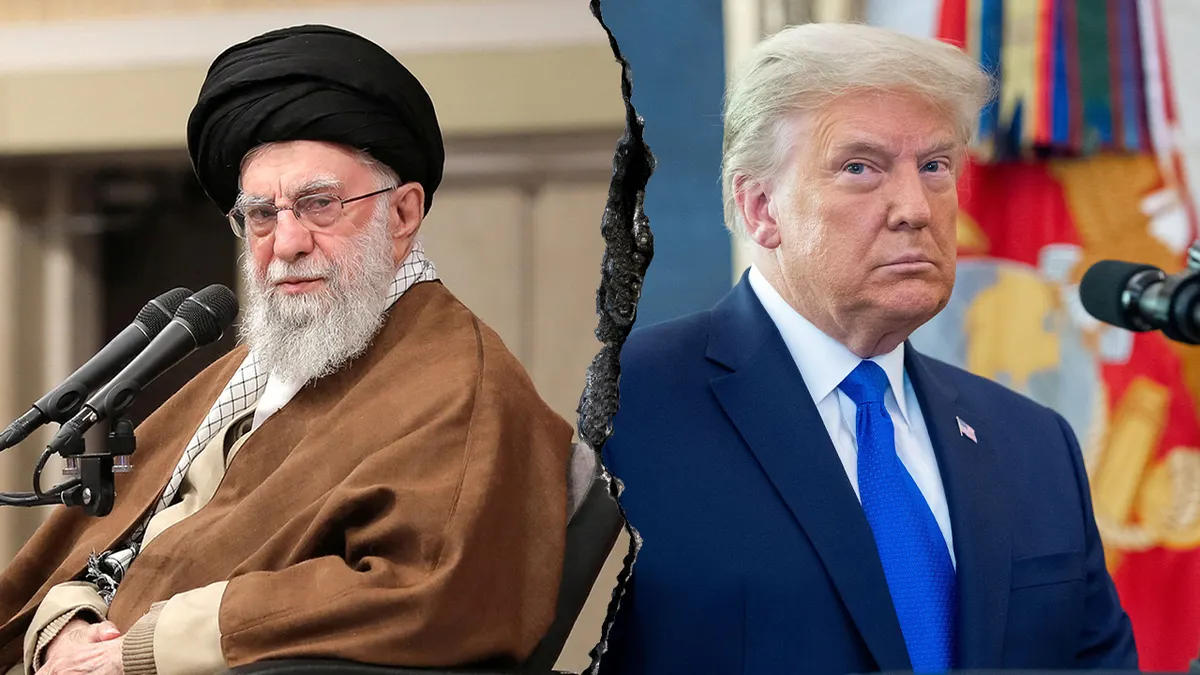
The future of peace negotiations in the Middle East is increasingly uncertain after Iran announced it would reconsider its involvement in ongoing talks. The development follows a sharp escalation in hostilities between Iran and the United States, with both sides exchanging military strikes overnight. Former US President Donald Trump warned that Iran would “pay the price,” further heightening tensions in a conflict that has repeatedly drawn neighbouring countries into a regional war since late February.
In the early hours of Wednesday, the United States launched strikes against Iranian targets, claiming the action was retaliation for Iran’s alleged downing of a US military helicopter near the Strait of Hormuz. Iran responded swiftly, launching airstrikes that it said targeted American military installations in Kuwait, Bahrain and Jordan.
The latest exchange marks the most serious escalation since a ceasefire was agreed in early April. Efforts to transform that ceasefire into a lasting peace agreement have struggled in recent weeks, with both sides accusing each other of violating the truce through sporadic military actions.
Iran’s Foreign Ministry spokesperson, Esmail Baqaei, said the American strikes had placed the diplomatic process at risk. He accused Washington of sending mixed messages and undermining efforts to maintain a stable environment for negotiations. Baqaei also criticised Israel, arguing that its continued military actions in Lebanon were damaging prospects for regional diplomacy.
“Following overnight events, we need to reassess the situation,” Baqaei said. “Any diplomatic process requires a minimum level of stability.”
Trump took a very different stance, arguing that Iran had delayed negotiations for too long and now faced the consequences. In a post on Truth Social, he claimed Iran’s military capabilities had been severely weakened and described the country as “all talk and no action.”
According to Fox News, Trump also suggested during a phone interview that further attacks on Iran’s infrastructure, including power plants and bridges, remained an option if negotiations continued to stall. While he has repeatedly threatened renewed military action since the April ceasefire, he has yet to fully act on those warnings.
Meanwhile, regional mediators have stepped up efforts to prevent further escalation. A delegation from Qatar, which has played a central role in mediation efforts, arrived in Tehran on Wednesday to discuss ways of reviving diplomatic talks and reducing tensions.
The conflict continues to have repercussions across the wider Middle East. Turkish President Recep Tayyip Erdoğan told lawmakers that Israeli military operations in Syria and Lebanon posed a threat not only to the region but also to global stability. Israeli Prime Minister Benjamin Netanyahu responded by calling Erdoğan an “antisemitic dictator” and rejecting his criticism.
Although violence has continued since the ceasefire, most military actions have been carefully calibrated, with both sides appearing to balance military pressure against their positions at the negotiating table.
The US military described its latest strikes as a “proportional response” to the helicopter incident. Officials said the attacks targeted Iranian air defence systems, radar installations and command centres. Iran reported strikes on Qeshm Island and the port city of Sirik, while local media also reported explosions in Bandar Abbas.
Trump defended the operation, saying the US response needed to be strong and decisive.
The conflict also affected maritime security. According to UK-based maritime security company Ambrey, two crew members of a tanker were reported missing and another injured following what was believed to be a missile strike linked to the US enforcement of its blockade against Iranian shipping.
In retaliation, Iran’s Islamic Revolutionary Guard Corps launched missile attacks targeting US military facilities in Bahrain, Kuwait and Jordan. The group warned that any further American military action would trigger an even stronger response.
US officials said the vast majority of Iranian missiles and drones were intercepted, with no immediate reports of casualties or significant damage. Authorities in Jordan, Kuwait and Bahrain also confirmed that incoming projectiles had been successfully intercepted.
Just hours before the American strikes, Iran’s parliamentary speaker, Mohammad Bagher Ghalibaf, issued a warning on social media, stating that while Iran preferred diplomacy, it was fully prepared to respond if agreements were broken.
Despite the escalating military confrontation, some US officials continue to express optimism about the possibility of reaching a diplomatic agreement. A senior White House official told Politico that military operations and negotiations could proceed simultaneously, suggesting that the latest violence had not completely derailed discussions.
Trump remains eager to secure a peace agreement as the United States approaches midterm elections amid economic pressures, including rising inflation and declining approval ratings. However, major disagreements remain unresolved.
Iran continues to demand the removal of international sanctions, access to frozen financial assets and greater control over the Strait of Hormuz. The United States insists that any future agreement must prevent Iran from acquiring nuclear weapons, a claim Tehran continues to reject.
The Strait of Hormuz remains a critical point of contention. The strategic waterway carries roughly one-fifth of the world’s oil supply, and restrictions imposed by Iran, combined with the US blockade of Iranian ports, have disrupted global shipping and energy markets. The resulting supply pressures have contributed to rising costs for fuel, food and other essential goods worldwide.
Another major obstacle to peace remains the conflict between Israel and Hezbollah in Lebanon. Iran has repeatedly insisted that any comprehensive ceasefire must include the Lebanese front, while both the United States and Israel have sought to separate the two conflicts.
Tensions escalated again on Sunday when Iran and Israel exchanged strikes for the first time since the April ceasefire after Israel carried out an attack in Beirut’s southern suburbs. Iran has warned it will retaliate if further strikes target the Lebanese capital. At the same time, Israel continues to conduct frequent operations in southern Lebanon, while Hezbollah maintains attacks against Israeli military positions.
According to available figures, Israeli strikes have killed more than 3,600 people in Lebanon since the latest phase of the conflict began. Hezbollah attacks have also resulted in the deaths of at least 30 Israeli soldiers and three civilians, underscoring the continuing human cost of a conflict that shows few signs of reaching a lasting resolution.